
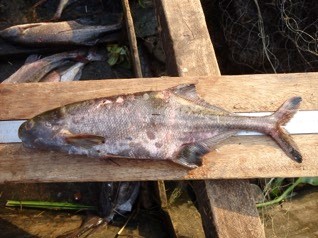
Common names:
Churchill
Local: unknown
Taxonomic tree
Kingdom: Animalia
Phylum: Chordata
Class: Actinopterygii (ray-finned fish)
Order: Osteoglossiformes (Fishes with bony tongue)
Family: Mormyridae (fishes with Elephant-like snout)
Genus: Petrocephalus
Species: Petrocephalus catostoma (Günther, 1866)
Number of Occurrancies: 45
Etymology (based on Sharpf & Lazara, 2018)
- Petrocephalus: petro, meaning stone; cephalus, meaning head, Latin translation of Arabic vernacular ras el hagar (“stonehead”), possibly referring to short, well-rounded (i.e., stone-like) snout
- catostoma: cato-, meaning low; stoma, meaning mouth, referring to how cleft of mouth is at lower side of snout
Synonyms:click here to view synonyms
Type locality: Ruvuma River, Tanzania/Mozambique, southern Africa. Lectotype at the British Museum of Natural History (BMNH)
General identification features for mormyrids: Elongate body; narrow and distinct caudal peduncle; opercular bones hidden beneath the skin, reduced opening of the branchial cabity reduced; small eyes covered by the skin; naked head, its skin thick and well supplied with mucus glands; small cycloid scales; and muscles of the caudal peduncle modified to form an electric organ, and the elaphant-like snout
Distinguishing characters for the genus
- Short dorsal and anal fins situated posteriorly
- Upper jaw extending beyond the lower jaw, with more than 12 teeth in the lower jaw
Distinguishing characters for the species
- Depth of the body contained up to 3-3.5 times in standard length, and length of the head 3.5-4 times
- Snout very short, 1/4-1/6 length of the head, rounded and slightly projecting beyond the mouth, which is situated below the eye
- Anterior nostril mid-way between the eye and end of the snout
- Teeth notched; 10-14 in the upper jaw and 17-22 in the lower jaw
- Dorsal fin with 19-24 rays, its origin above the first anal fin ray
- Anal fin with 25-30 rays, equally distant from the origins of the pelvic and caudal fin
- Caudal fin with pointed lobes, scaled on the basal part only
- Lateral line with 34-39 scales; 12 around the caudal peduncal, which is 2-3.5 times longer than deep, and about as long as the head
- Colour is dusky silver above, whitish below
Distribution in Uganda: Lakes Victoria, Nabugabo, Victoria Nile
Occurence: Native
Habitat: Demersal, inhabiting waters just above the bottom; in the Victoria Nile, it is found amongst rocks in areas where current is fast; potamodromous.
Feeding: Information on food from Ugandan waters is lacking, but generally the species is insectivorous, feeding on insect larvae and other inverterbrates at night.
Biology: Information is scanty. The maximum recorded size from Ugandan waters is 9 cm standard length. No information on breeding; elsewhere, the species is known to undergo upstream migration, esepecially during rainy seasons, whihc may be linked to spawning .
Economic importance/End use: Local subsistence (for food).
IUCN conservation status: click here to view IUCN status
Threats: River damming for hydro-electric power generation; Clearence of papyrus swamps and marginal wetlants; fishing of juveniles for baits in the Nile perch fishing industry.
Main references
- Greenwood PH. 1966. The fishes of Uganda. The Uganda Society, Kampala. 131 pages.
- Sharpf C, Lazara J.K. 2018. Fish Name Etymology Database v16. www.etyfish.org
