
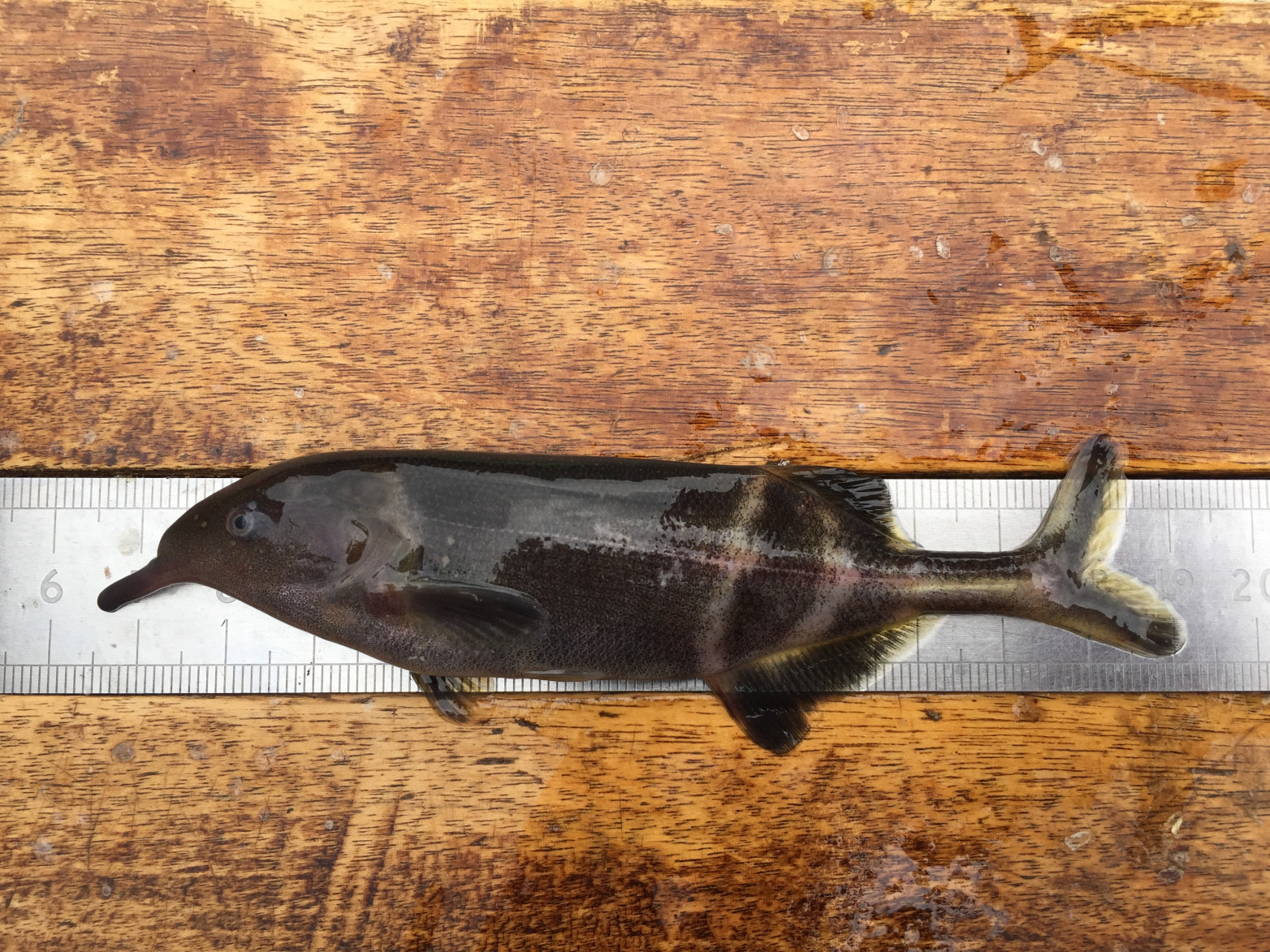
Common names:
Longnose stonebasher
Lunyoro/Lunyara/Lango/Ludope: Nkoiro Lukenyi: Mpumbi Luganda: Ekumbi
Taxonomic tree
Kingdom: Animalia
Phylum: Chordata
Class: Actinopterygii (ray-finned fish)
Order: Osteoglossiformes (Fishes with bony tongue)
Family: Mormyridae (fishes with Elephant-like snout)
Genus: Gnathonemus
Species: Gnathonemus longibarbis (Hilgendorf, 1888)
Number of Occurrancies: 69
Etymology(based on Sharpf & Lazara, 2018)
- Gnathonemus: gnathos, jaw; nema, thread, referring to lower jaw with a “conical flap or barbel”
- longibarbis: longus, long; barbis, barbel, referring to longer barbels (nearly equal to snout length) than Mormyrus (=Marcusenius) ussheri
Synonyms:click here to view synonyms
Type locality: Lake Victoria, Ukerewe (Kageyi, east of Kayenze, southern shore of Lake Victoria), Tanzania. Holotype at Zoologisches Museum Berlin (ZMB)
General identification features for mormyrids: Elongate body; narrow and distinct caudal peduncle; opercular bones hidden beneath the skin, reduced opening of the branchial cabity reduced; small eyes covered by the skin; naked head, its skin thick and well supplied with mucus glands; small cycloid scales; and muscles of the caudal peduncle modified to form an electric organ, and the elaphant-like snout.
Distinguishing characters for the genus
- Lower jaw extending beyond the upper jaw
- Chin with a long fleshy appendage
Distinguishing characters for the species
- Depth of the body contained up to 3.66-5 times in standard length, and length of the head (excluding the lower lip) 4-4.5 times
- Upper head profile gently curved
- Snout 1/2-3/4 length of post-ocular part of the head
- Chin produced into a long, cyrindrical and fleshy appendage which is as long as, or longer than the snout (Diagnostic)
- Mouth terminal; teeth in a single series restricted to the middle of each jaw, small and notched, 3-5 and 4-6 in the upper and lower jaws, respectively
- Dorsal fin with 22-25 rays, its origin is slightly behind the insertion the anal fin
- Anal fin with 28-31 rays
- Caudal fin with pointed lobes, and almost entirely covered with small scales
- Lateral line with 58-64 scales; 10-12 around the caudal peduncal, which is 2-2.5 times longer than deep
- Colour is variable depending on habitat, but typically dark brown, lighter ventrally
Distribution in Uganda: Lake Victoria basin, Victoria Nile and Lake Kyoga
Occurence: Native
Habitat: Demersal, inhabiting waters just above the bottom; common in shallow inshore waters over both sandy and rocky bottoms; potamodromous. In Lake Kyoga, the species is abundant in water-lily swamps.
Feeding: Primarily insectivorous, feeding mainly on insect larvae especially of chironomidae and odonata, but can also feed on marginal vegetation, arthropods, oligochaetes and fish eggs
Biology: Sexually mature fishes range between 23-36 cm long. The species migrates up the river during the rainy seasons to spawn; spawning typically occurs twice a year in upstream waters during rainy seasons.
Economic importance/End use: Local subsistence (for food).
IUCN conservation status: Click here to view IUCN status
Threats: River damming for hydro-electric power generation; Clearence of papyrus swamps and marginal wetlants; fishing of juveniles for baits in the Nile perch fishing industry.
Main references
- Greenwood PH. 1966. The fishes of Uganda. The Uganda Society, Kampala. 131 pages.
- Sharpf C, Lazara J.K. 2018. Fish Name Etymology Database v16. www.etyfish.org.
