
Common names:
Unknown
None
Taxonomic tree
Kingdom: Animalia
Phylum: Chordata
Class: Actinopterygii (ray-finned fish)
Order: Cichliformes (Cichlids)
Family: Cichlidae (Cichlids)
Genus: Mbipia
Species: Mbipia mbipi (Lippitsch & Bouton 1998)
Number of Occurrancies: 121
Etymology(based on Scharpf & Lazara (2019)
- Mbipia: from the word Mbipi, the dark ones, Kisukuma (most common language spoken in the southeastern Lake Victoria region) word for most rock cichlids, referring to rather dark appearance of adult males
- mbipi: same as genus.
Synonyms: click here to view synonyms, but also see taxonomic remarks below
Type locality: Speke Gulf, Makobe Island, Lake Victoria, Tanzania. Holotype at Rijksmuseum van Natuurlijke Historie (RMNH)
General identification features for haplochromine cichlids
- A single nostril on each side of the head; dorsal fin with contineous spinous and soft-rayed parts; lateral line interrupted(with anterior superior part and posterior inferior part)
- Ctenoid scales
- Juveniles lack tilapia mark (dark spot at the posterior end of the dorsal fin)
Distinguishing characters for the genus(From Seehausen et al., 1998)
- A moderately steep to steep dorsal head profile, that is usually straight in males, often with little concavity rostrad of the eye; in females slightly convex;
- Orientation of the mouth gape is horizontal; head moderately long, usually 31-35% of SL; a broad lower jaw (26-33% of head length, 1.15-1.5 times longer than broad, vs. 1.5-2), and not tending to be square-shaped;
- Jaw is isognathus, snout obtuse, the lower jaw slightly protruding; teeth in the outer tooth row very movably implanted (vs. firmly attached), three to more than six rows of inner teeth (vs. 2 or 3), forming broad bands anteriorly and anterolaterally in both jaws;
- Flank scales much higher than wide, but with granulation of Nechromis type;
- Lips not enlarged except in large males, but only rarely slightly thickened;
- Scales that cover the anal/genital region region cycloid (vs. ctenoid or mixed); scales on the caudal fin densely covering the rays (vs. staggered on the membranes or along the rays.
Distinguishing characters for the species (From Seehausen et al., 1998)
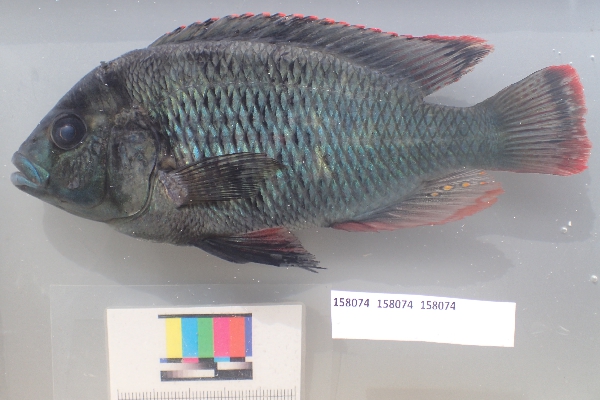
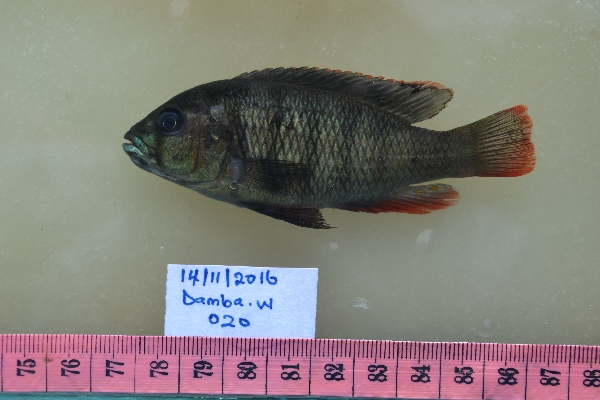
- Robust, medium-sized, deep-bodied haplochromine with a relatively steep but straight dorsal head profile, with slight concavity rostrad of the eye;
- Strongly ctenoid scales on the rostral part of the body; a mixture of small cycloid and larger ctenoid scales in the anal/genital region; presence of cycloid scales on the spiny part of the dorsal fin.
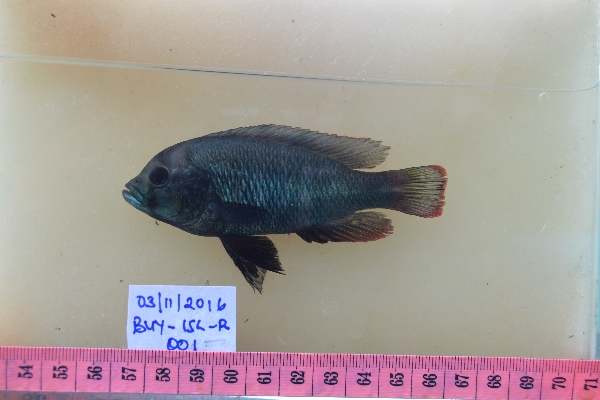
- Color (for males) is dark slate to velvety black all over head, flanks and fins, with only an ill-defined rim of the caudal fin, lappets of the dorsal fin and large part of the anal fin dull to bright red; a coppery sheen on preoperculum and operculum (some populations may have metallic blue reflections on the snout and lips.
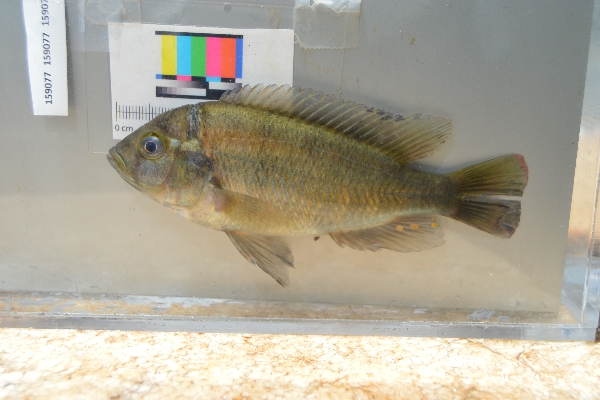
- Females light to dark brown, often small yellow spots in place of the egg dummies on the anal fin.
Taxonomic remarks: We adopt the genus Mbipia, which is valid in Catalog of Fishes (Eschmeyer et al. 2019), based on Seehausen et al. 1998, although FishBase (Froese and Pauly, 2019) lists the species in genus Haplochromis based on Van Oijen 1996.
Distribution in Uganda: Lake Victoria and Victoria Nile
Occurence: Native
Habitat: Stony and rocky habitats, including stone-sand mixed substrates with fast water flow (predominatly in rapids) (Seehausen et al. 1998).
Feeding: Epilithic omnovore: can ingest diatoms, filamentous epilithic algae, detritus, insect larvae, Bryozoa, detritus (Seehausen et al. 1998).
Biology: Polygynous mouth-brooder with maternal parental care; spawning takes place throughout the year; males are territorial, and territorial disputes are common; length at 50% maturity is about 8.5 cm SL in males and 6.3 cm SL in females (Seehausen et al. 1998).
Economic importance/End use: Unknown.
IUCN conservation status: click here to view IUCN status
Threats: In the main lake predation by Nile perch habitat degradation, and alteration of water flow through damming for riverine populations.
Main references
- Seehausen, O., Lippitsch, E., Bouton, N. and Zwennes, H. 1998. Mbipi, the rock-dwelling cichlids of Lake Victoria: description of three new genera and fifteen new species (Teleostei). Ichtyological exploration of Freshwaters 9: 129-228.
- Froese, R. and D. Pauly. Editors. 2019. FishBase. World Wide Web electronic publication. www.fishbase.org, version (02/2019)
- Sharpf C, Lazara J.K. 2019. Fish Name Etymology Database v6. www.etyfish.org
- Eschmeyer, W.N., Fricke, R. and Van der Laan, R. (eds). 2019. Catalog of Fishes: genera, species, references. Updated 1 July 2019. Available at: http://researcharchive.calacademy.org/research/ichthyology/catalog/fishcatmain.asp. (Accessed 10 July 2019)
- van Oijen, M.J.P. 1996. The generic classification of haplochromine cichlids of Lake Victoria, East Africa. Zoologische Verhandelingen 302: 57-110.

" Remove the occurrence records in Kwania "
May 23, 2022, 3:37 p.m.